Investors and partners
White Nordic is a custom production workshop in Riga, Latvia, that already runs its customer work with AI. We are looking for investors and partners for the next step: a pilot of robots that learn workshop tasks from our own craftsmen, and later a package that other workshops can adopt.
In short
- Company
- White Nordic is the trading name of SIA "Black line", registered in Riga, Latvia, on 14 July 2020 (Reg. No. 44103147647). Jura, our founder and craftsman, has run the workshop since 1996.
- What we make
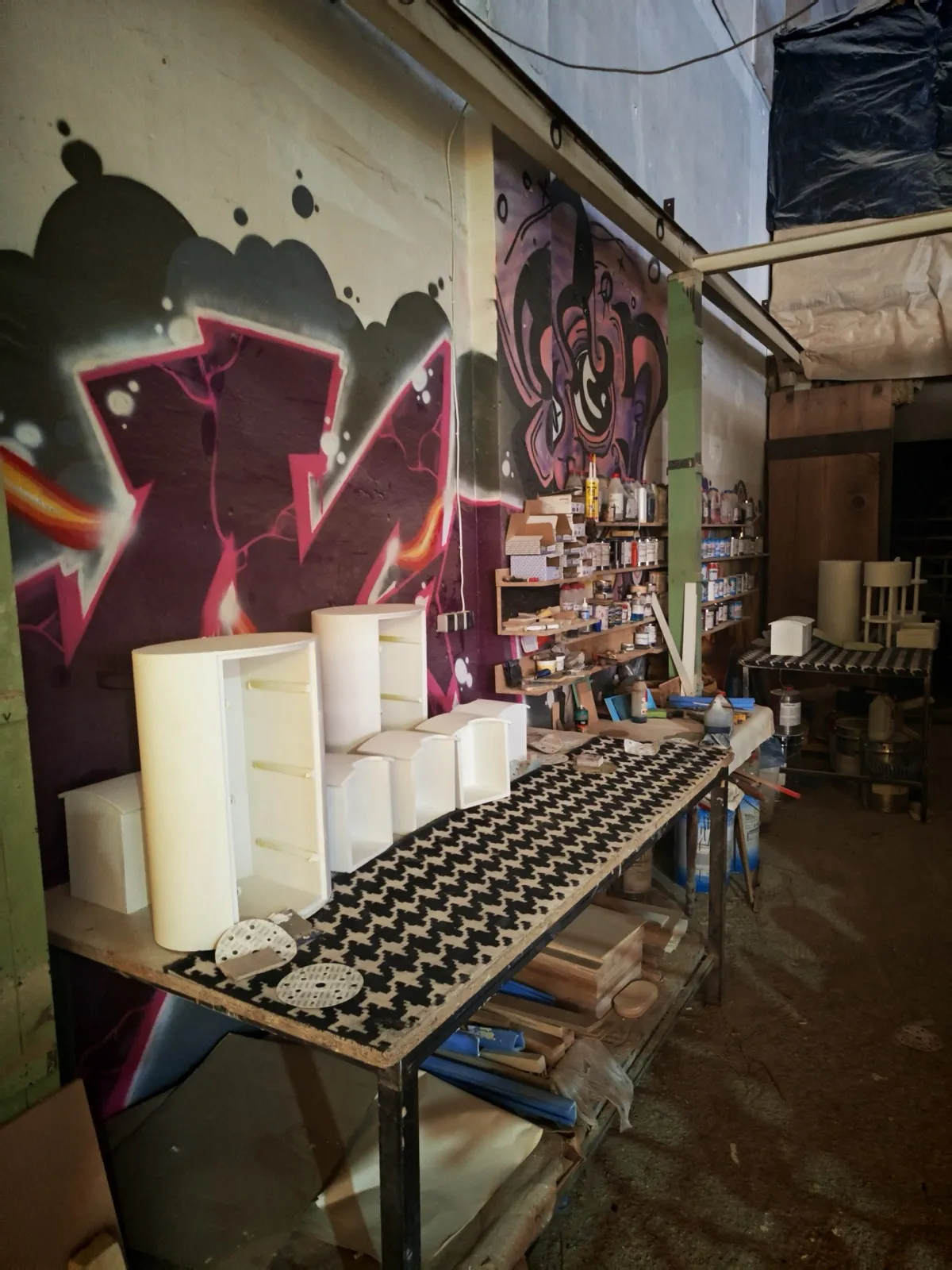
- Custom pieces in wood, steel and acrylic, from one piece to a full series: signs, displays, furniture, gift packaging and shop fit-outs. No minimum order.
- The workshop
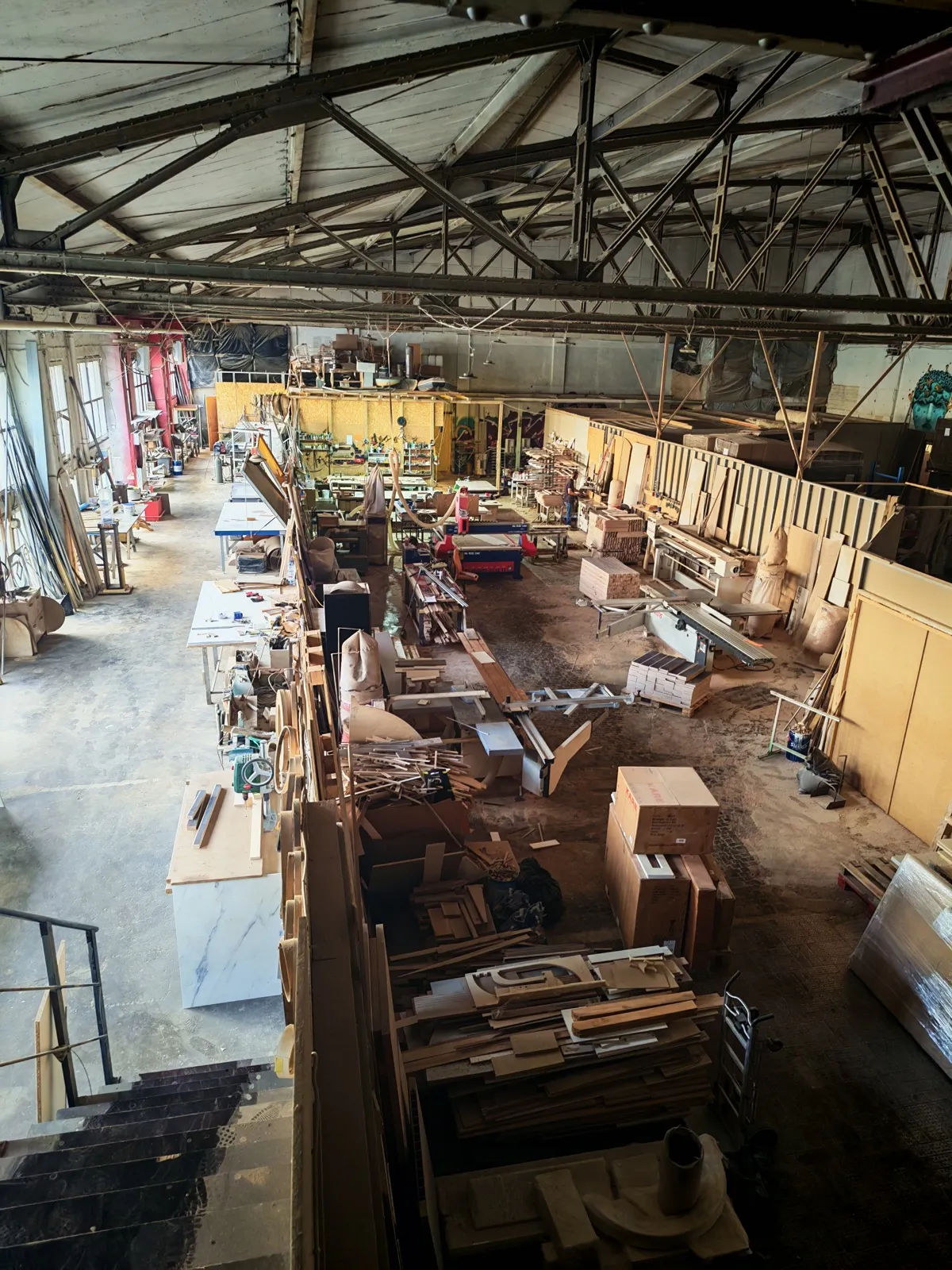
- One production floor in Riga with panel saws, CNC milling, edge banding, welding, laser cutting and a spray room.
- AI in daily use
- An AI operations agent helps with enquiries, customer records and alerts. Since 26 September 2026, custom orders get AI-assisted 3D designs on private review pages: 10 customers so far.
- Robotics
- A proposed pilot in our Riga workshop: robots that learn tasks such as sanding from our craftsmen’s demonstrations. No robot works on our floor yet.
- After the pilot
- A package for partner workshops in other countries: a robot cell, the skills it has learned and our AI order system, set up by us. Paid trials first; a franchise only once the pilot proves safe and economic and others can set up and support the package.
- We are looking for
- Early-stage investors, a robotics lead, a machinery-safety partner, technology partners and workshops for the first trials. Write to [email protected].
What we already do with AI
These systems are in daily use with real customers. We set them up and connect them ourselves, with AI coding tools.
-
An AI operations agent
Since September 2026, an operations agent on our own server, calling outside AI models, has completed more than 6,000 scheduled runs: it checks the inbox every 30 minutes and new orders every 15. It keeps a record for each customer, updates each deal on our task board and alerts the team on Telegram. It flags messages that mention damage, a cancellation, a refund, a hard deadline or legal steps for a person to review. The team stays in charge of every reply.
-
Private 3D review pages for custom orders
Since 26 September 2026, we design custom pieces with AI tools and publish them on private pages with an interactive 3D model, the details and the quote. The customer turns the model, replies on the page or by email, and approves the design before anything is cut. By 14 October 2026 we had published 56 design versions on 11 pages for 10 customers. For the five enquiries that arrived after launch, the first 3D version followed the customer’s first email after a median of 8.7 hours (from 1.9 to 31.1 hours). That is a measurement, not a turnaround promise.
-
A website that people and AI assistants can read
96 pages of real work from our floor, each with a quote form, and 30 design ideas shown as clearly labelled AI concepts. The site is open to search engines and AI assistants, with a plain-text summary at whitenordic.com/llms.txt.
Why robots, and why a custom workshop
-
The problem
Custom work changes with every order. Classic industrial robots are programmed for one part at a time, and in a workshop like ours the programming, fixtures and commissioning for each new part can cost more than the robot saves. That is why sanding, loading and packing are still done by hand on our floor.
-
Why now
Robots can now learn a task from human demonstrations, and a robot cell can be modelled and tested in simulation on GPUs before it touches a real part. That could make each new part much cheaper to automate. We have not proven it in our workshop yet, and that is what the pilot is for.
-
Why us
We have real orders in varied materials, a founder with thirty years at the bench, and an order pipeline that is going digital: since 26 September we have published private 3D review pages for 10 customers. What we do not have yet is robot training data. The pilot starts collecting it.
The pilot in our Riga workshop
This is a proposed plan. Every step is measured, and learning from demonstration has to beat a conventional robot program to stay in it.
-
Find the bottlenecks
Measure where time goes on our floor today and choose the first tasks from that data, with a manual baseline for each one.
-
Teaching sessions
Craftsmen would wear motion-sensing wristbands during agreed teaching sessions, while cameras and sensor-fitted tools record the part, the tool path and the pressure. Wristbands alone miss the forces, so we would record both.
-
Simulation first
A digital model of the robot cell, built with tools such as NVIDIA Isaac Sim, would check reach, collisions and changeovers, and we would use Isaac Lab to test learning from the recorded demonstrations before a robot touches a real part.
-
The first robot cell
Guarded sanding of flat and gently curved wooden parts. Then loading and unloading the CNC router with standard fixtures, then packing and assembly in jigs. Spray finishing comes later, after specialist ventilation and safety engineering.
-
Compare honestly
Each task would be compared with the manual baseline and with a conventional robot program: the share of runs completed without help, accepted quality, cost per accepted part and the time it takes to set up a new part. If ordinary automation wins, we will use it.
Our craftsmen stay in charge
- Recording will happen only in agreed teaching sessions, and only of the task.
- No emotion recognition, no performance scoring and no biometric identification. Teaching data will never be used to monitor people.
- Before any recording, we will document a lawful basis, complete a data protection impact assessment, inform the workers, consult their representatives and set retention, access and transfer rules.
- Robots would take the dusty, repetitive work. Craftsmen decide what the robots learn and sign off the quality.
- The robot cell will be assessed under EU machinery safety rules with a safety partner, and it will not run unattended during the pilot.
After the pilot: a package for other workshops
If the pilot works, we want small custom workshops in other countries to get the same system without building it themselves.
-
What a partner workshop gets
A specified robot cell with tooling, fixtures, extraction and a safety system, set up and commissioned by us; training for its team; a subscription to the validated skills and their updates; and, if it wants, our AI order system with the operations agent and the 3D review pages.
-
How it grows
First, paid trials with two or three partner workshops. A franchise follows only once people outside our team can commission and support the package and the partners’ numbers work.
-
Every workshop teaches the next
With each partner’s agreement, skills validated in one workshop are added to the shared library, where every other member can test and validate them on its own machines.
-
How we earn
Set-up and commissioning, a recurring subscription for skills, software and support, extra process modules and training, and later brand licensing. Robot hardware is financed through partners where possible, so we do not become a low-margin reseller.
Where we are
-
Done, September to October 2026
AI on the customer side
The operations agent, the private 3D review pages and a website built for search engines and AI assistants.
-
Next
Preparation
A bottleneck study, safety and data protection assessments, the teaching setup and a simulation of the first cell.
-
Then
The first robot cell in Riga
Sanding first, measured against the manual baseline.
-
Then
Two or three partner workshops
Paid trials of the package outside our own floor.
-
Later
The franchise
Once partners can run the package and the numbers work for them.
What we are looking for
-
Investors
Early-stage capital for the pilot: the robot cell, sensors, compute and a robotics engineer. We share our numbers, plans and terms privately.
-
A robotics lead and a safety partner
An engineer to lead robot learning and integration, as a hire or a partner, and a machinery-safety partner for the cell.
-
Technology and research partners
Makers of robot arms, grippers and sensors, simulation and robot-learning platforms, and research groups working on learning from demonstration.
-
Workshops
Owners of custom wood, metal or plastic workshops who want to join the first trials.
-
Programmes
EU and Latvian innovation programmes for AI and robotics in manufacturing.
Questions
- Is White Nordic looking for investment?
- Yes. We are looking for early-stage investors and partners for a robotics pilot in our Riga workshop. We share numbers, plans and terms privately: write to [email protected] with the subject "Investors".
- Does White Nordic use robots today?
- No. Our floor runs on CNC machines and skilled people. The robots are the plan described on this page.
- What does White Nordic use AI for today?
- An AI operations agent helps us read customer email, keep customer records, update deals and alert the team. Since 26 September 2026, custom orders get AI-assisted 3D designs on private review pages (10 customers so far). AI concept images on our website are always labelled as AI.
- What are the wristbands for?
- In the proposed pilot they would record how a craftsman moves a tool during agreed teaching sessions, together with cameras and sensor-fitted tools, so that a robot can learn the task. They would never be used to monitor or score anyone.
- What would a partner workshop get?
- A robot cell set up by us, training, the validated skills and their updates, and optionally our AI order system. It starts as paid trials with two or three workshops.
- Where is White Nordic?
- Klijānu iela 14, Riga, Latvia. The company, SIA "Black line", was registered in 2020; the workshop has worked since 1996.
- Is this page an offer of shares?
- No. It describes our business and our plans. It is not an offer of securities.
Talk to us
Write to [email protected] with the subject "Investors". Tell us who you are and what interests you. We reply personally and share the numbers and the detailed plan privately.
Write to usUpdated 14 October 2026. This page describes our current business and our plans. The plans and steps are intentions, not promises of results, and this page is not an offer of securities. NVIDIA, Isaac Sim and Isaac Lab are trademarks of NVIDIA Corporation; naming them describes tools we plan to use, not a partnership.